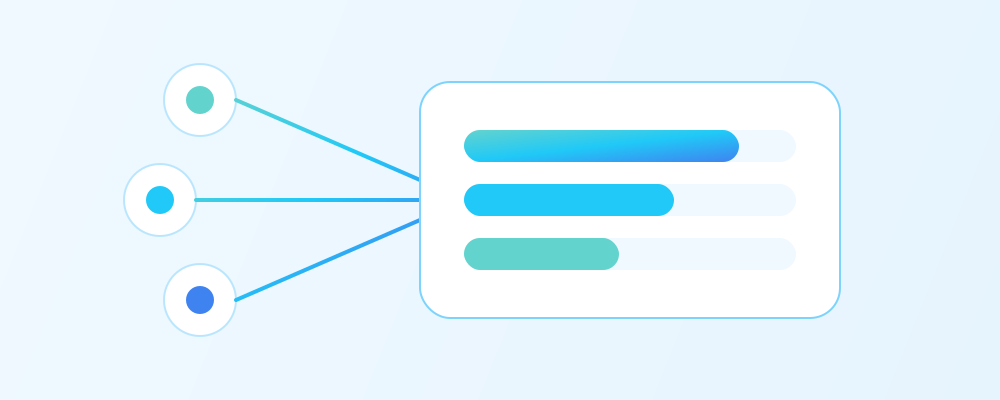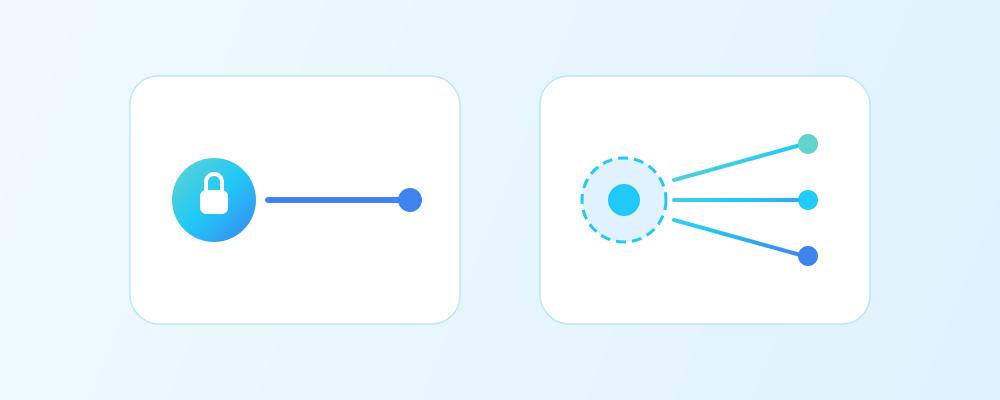
Should your automation workers rotate to a new IP on every HTTP request, or maintain a persistent sticky session tied to a dedicated static IP? To answer this with hard engineering data, we benchmarked 50 concurrent worker threads running multi-step stateful tasks (login, CSRF token fetch, form submission, and pagination) across both models.
1. Multi-Worker Benchmark Results (10,000 Stateful Flows)
| Metric | Dedicated Static ISP (1 IP per Worker) | Per-Request Rotating Pool |
|---|---|---|
| End-to-End Flow Completion | 99.2% | 64.8% (Failed on CSRF/IP mismatch) |
| Median Response Latency (P50) | 68 ms (Direct carrier backbone) | 490 ms (P2P relay hop overhead) |
| P99 Tail Latency | 145 ms | 2,850 ms (Dead peer timeouts) |
| Bandwidth Cost Predictability | Fixed monthly cost ($0/GB traffic fee) | High per-GB burn from repeated retries |
2. Why Multi-Step Workflows Break Under Rapid IP Rotation
Modern web applications and campaign polling systems (VOTEBOT / checkout queues) rarely process actions in a single stateless GET request. A typical workflow requires:
- Fetching the landing page and receiving an encrypted session cookie + CSRF token.
- Submitting a POST payload signed with that token from the exact same IP subnet.
- Polling a status endpoint over WebSockets or XHR for 30–120 seconds.
When a rotating proxy switches your exit IP between Step 1 and Step 2, the server invalidates the session token immediately.
3. Designing a Deterministic Worker-to-IP Pool
For high-concurrency automation, assign a dedicated Static ISP Proxy or Dedicated Datacenter Proxy to each worker slot using a ring-buffer queue. Each worker keeps its own cookie jar, TLS session cache, and rate-limit cooldown timer—maximizing throughput without triggering anomaly detectors.
Глубокая инженерная архитектура и руководство по внедрению
In real-world production deployments covering benchmarking sticky static ISP sessions against per-request rotating proxies in multi-worker concurrency, engineering teams quickly discover that surface-level proxy configuration is not enough. Target platforms across Multi-step checkout pipelines, authenticated API scraping, Votebot campaign workers, and pagination crawlers evaluate every incoming connection across three synchronized telemetry planes: Network Autonomous System (ASN) & RIR reputation, Transport-Layer (TCP/TLS/HTTP2) handshake consistency, and Application-Layer session persistence.
By pairing Dedicated Static ISP Proxies with 10Gbps Dedicated Datacenter Proxies inside your High-Concurrency Automation & Queue Systems workflow, you establish deterministic isolation that prevents cross-account contamination and eliminates unpredictable bandwidth surcharges.
Проверка в продакшене и шаблон CLI / кода
Before scaling your worker pool or binding dozens of profiles, run the following verification blueprint to validate routing hygiene, credential authentication, and protocol alignment (Persistent TCP/TLS connection pooling, stateful cookie/CSRF session integrity, and deterministic worker-to-IP sharding):
# Deterministic 1:1 Worker-to-Static-IP assignment in Python concurrent workers
from concurrent.futures import ThreadPoolExecutor
import requests

STATIC_IPS = [f"http://USER:PASS@isp-{i:02d}.mantaproxy.com:10000" for i in range(1, 11)]

def run_stateful_worker(worker_id: int, proxy_url: str):
    with requests.Session() as s:
        s.proxies.update({"http": proxy_url, "https": proxy_url})
        # Step 1: Fetch session cookie & CSRF token
        init = s.get("https://httpbin.org/cookies/set/session_id/xyz123", timeout=10)
        # Step 2: Subsequent request reuses exact same IP and TLS socket
        verify = s.get("https://httpbin.org/cookies", timeout=10)
        return worker_id, verify.status_code
Pro Tip: Always test newly provisioned endpoints against the MantaProxy Free IP Purity Checker first to confirm that the exit IP, ASN classification, recursive DNS resolver, and regional timezone match your target market 1:1.
Частые коды ошибок, сбои и таблица диагностики
Even with high-purity static proxies, misconfigured client libraries, OS-level DNS overrides, or aggressive concurrency settings can trigger avoidable blocks. Use the diagnostic matrix below to isolate and resolve issues in minutes:
| Симптом / HTTP-код | Техническая причина | Инженерное решение |
|---|---|---|
HTTP 407 Proxy Auth Required | Invalid sub-user credentials, special character encoding issue, or unsynced IP whitelist | Verify proxy username/password in the MantaProxy Usage Guide and URL-encode special symbols |
HTTP 429 Too Many Requests | Per-IP sliding window velocity exceeded or synchronized burst across workers | Introduce randomized log-normal jitter (1.5s–5.0s) and shard tasks across additional Dedicated Static ISP Proxies |
HTTP 403 / Turnstile Loop | TLS JA3/JA4 mismatch, HTTP/1.1 fallback, or rotating IP mid-session after cookie issue | Lock 1 static IP per session cookie jar and use Playwright or curl_cffi with HTTP/2 enabled |
Geo / Currency Mismatch | Local DNS leak (using socks5:// instead of socks5h://) or stale browser cookies | Enforce remote proxy DNS resolution (socks5h://) and align Accept-Language + timezone |
Connection Reset / Timeout | Client connection pool exhaustion or ephemeral port starvation under high concurrency | Reuse persistent Session / AsyncClient pools with bounded Semaphore limits |
Архитектура масштабирования и оптимизация ROI
When scaling from a small pilot of 5 IPs to an enterprise matrix of 100+ dedicated nodes, optimizing your proxy tier mix can reduce total infrastructure spend by 40% to 65% while improving account survival rates:
- Tier 1 — High-Trust Account & Payment Anchors (Native Static Residential): Reserve 100% native local-carrier IPs for your highest-value revenue assets—such as flagship TikTok Live/Shop accounts, Amazon Seller Central logins, PayPal/Stripe checkouts, and localized ad-verification audits.
- Tier 2 — Daily Multi-Account Matrix & Fast Checkout (Static ISP Proxies): Use carrier-grade Static ISP proxies (starting at
$5.99 / IP / mowith unlimited traffic) for everyday multi-account social matrices, anti-detect browser profiles, localized SEO rank tracking, and low-latency retail drop tasks. - Tier 3 — High-Throughput Public Crawling (Dedicated Datacenter Proxies): Offload high-volume public catalog discovery, sitemap auditing, and open API polling to 10Gbps Dedicated Datacenter IPs (starting at
$3.99 / IP / mowith unlimited bandwidth) so you never waste residential capacity on static assets. - Lifecycle & Renewal Hygiene: Lock in 90-day, 180-day, or 360-day billing cycles on the MantaProxy Pricing Page and enable Auto-Renewal so long-term accounts never experience an unexpected IP change.
Часто задаваемые вопросы (FAQ)
Q1: What is the difference between a 'Sticky Rotating Session' and a true 'Static ISP Proxy'?
A sticky session on a P2P rotating network tries to keep the same consumer peer IP for 10 or 30 minutes, but if that peer goes offline after 2 minutes, your IP still changes mid-task. A true Static ISP Proxy is permanently hosted on carrier backbone hardware and never changes IP during your subscription.
Q2: Why do per-request rotating proxies have 5x to 10x higher tail latency (P99)?
Every time a rotating gateway switches your exit node, your client must perform a brand-new DNS lookup, 3-way TCP handshake, and TLS 1.3 key exchange through a residential home router—adding 400ms to 2,500ms of overhead.
Q3: When is per-request IP rotation still useful?
Stateless, single-page public scraping where no login, CSRF token, or pagination session cookie is required. For any workflow involving 2+ sequential requests per user journey, sticky static IPs deliver far higher completion rates.
Q4: How does unlimited traffic on Static ISP proxies lower total cost of ownership?
In high-concurrency automation, retry storms and HTML/JS asset loading quickly burn hundreds of gigabytes. Fixed-price Static ISP IPs eliminate unpredictable per-GB bandwidth bills.